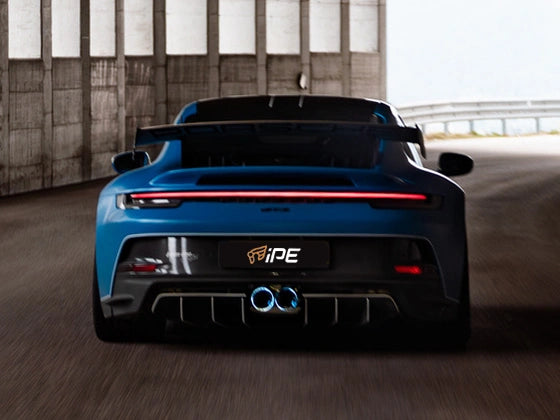

The Porsche 992 GT3 RS delivers one of the most emotional naturally aspirated engines on the market. However, modern emissions regulations — particularly the OPF (Otto Particulate Filter) — significantly reduce exhaust volume and character.
For many owners, upgrading the exhaust system is one of the most important modifications. This guide explains the full range of available upgrade paths, from OPF-back systems to complete equal length header configurations.
We focus on the leading brands: iPE and Akrapovič, including both stainless steel and titanium options.
For a complete GT3 RS setup, see our Porsche 992 GT3 RS Performance Upgrade Guide.
Factory GT3 RS exhaust & OPF explained
The factory GT3 RS exhaust system is heavily restricted by OPF filters. While this maintains emissions compliance, it also suppresses sound.
- Reduced volume
- Muted high-RPM tone
- Lower emotional engagement
Because of this, many owners seek upgrades that preserve drivability while restoring sound.
OPF-back exhaust systems
OPF-back systems replace the rear section while retaining factory OPF filters.
Advantages:
- No engine fault codes
- OEM compatibility
- Improved sound
- Simpler installation
- Often road legal depending on market
This is typically the safest option for daily-driven cars.

Full exhaust systems
For maximum performance and sound, full systems replace larger sections of the factory exhaust.
Standard full systems
These systems integrate with OEM-style routing while improving flow.
- More aggressive sound
- Higher flow
- Retains compatibility with many factory components
Equal length full systems
Equal length headers fundamentally change the exhaust pulse timing, delivering a sharper, more motorsport-inspired sound signature.
- Maximum sound transformation
- Distinctive high-RPM tone
- Track-oriented performance
This is often considered the ultimate GT3 RS exhaust configuration.
Equal length headers explained
Equal length headers optimize exhaust pulse synchronization, improving scavenging and creating a more exotic sound profile.
Compared to standard headers:
- Sharper tone
- Higher motorsport character
- Potentially improved flow
For enthusiasts seeking the most dramatic transformation, equal length headers are often the preferred solution.
Titanium vs stainless steel
| Material | Advantages | Best for |
|---|---|---|
| Stainless Steel | Durability, cost efficiency, deeper tone | Balanced builds |
| Titanium | Lower weight, premium finish, sharper sound | Maximum performance |
Titanium systems generally deliver the highest-end experience, while stainless steel often provides better value.
iPE vs Akrapovič
iPE
- Modular system structure
- OPF-back options
- Full systems
- Equal length configurations
- Stainless & titanium options
Akrapovič
- Premium titanium engineering
- Refined sound signature
- Exceptional build quality
- Typically more conservative than iPE
In short:
- iPE: Maximum flexibility & sound
- Akrapovič: Premium OEM+ refinement
Explore:
FAQ – Porsche 992 GT3 RS Exhaust
Does OPF-back cause fault codes?
No, OPF-back systems generally avoid check engine lights.
Are equal length headers louder?
Yes, significantly. They offer one of the biggest sound changes.
Is titanium worth it?
For weight savings and premium quality, yes.
Which system sounds best?
Equal length titanium systems are generally considered the most aggressive.
Why BaanVelgen
At BaanVelgen, we help configure exhaust systems based on usage, whether daily driving, road use or track focus.
Need help choosing the right GT3 RS exhaust? Contact BaanVelgen.
Precision. Performance. Perfection.