
Updated September 2026. BMW M has now revealed both the technical direction and the design language of its first fully electric high-performance models based on Neue Klasse technology. The information is substantial: four electric motors, wheel-specific drivetrain and braking control, 800-volt architecture and a battery with more than 100 kWh of usable energy.
What BMW has not yet confirmed is equally important. The production model has not officially been named BMW M3, “ZA0” has not been formally announced as its production code, and final figures for power, acceleration, range, dimensions, wheel fitment and pricing remain unknown.
This guide separates what BMW has officially confirmed from what is expected and what remains unknown.

What BMW Has Officially Confirmed
BMW M has confirmed that its first high-performance vehicles using Neue Klasse technology are planned to reach the market in 2027. These will be fully electric BMW M models developed around a dedicated version of BMW’s Gen6 electric architecture.
- Market introduction: the first BMW M models with Neue Klasse technology are planned for 2027.
- Four electric motors: one motor will drive each individual wheel.
- BMW M Dynamic Performance Control: the drivetrain and braking systems will be controlled at wheel level.
- Heart of Joy: BMW’s central driving-dynamics computer will coordinate power delivery, traction, braking and energy recuperation.
- Selectable drivetrain character: the front axle can be decoupled, allowing the car to operate with rear-wheel-drive characteristics while also improving efficiency in suitable conditions.
- 800-volt architecture: designed to support high charging performance and the demands of repeated high-performance driving.
- More than 100 kWh usable battery capacity: BMW has confirmed a performance-optimised Gen6 high-voltage battery with over 100 kWh of usable energy.
- Structural battery integration: the battery housing connects to both axles and contributes to overall vehicle stiffness.
- Natural-fibre components: BMW M plans to introduce natural-fibre elements within the fully electric high-performance model range.
These details are not based on third-party reports. They come directly from BMW Group’s official technical announcement.

The BMW M Concept Neue Klasse
BMW M presented the BMW M Concept Neue Klasse as a preview of its future all-electric design and technology direction. The concept combines wide wheel arches, a low silhouette, motorsport-inspired aerodynamics and extensive use of natural-fibre materials.
BMW describes the concept as a bridge between the history of BMW M, motorsport and its all-electric future. Its aerodynamic elements include a front splitter, dedicated air routing, M-specific exterior mirrors, a rear ducktail spoiler and a diffuser-inspired rear section.
The concept itself is not intended for sale. BMW states that elements of its design, materials, driving experience and overall interpretation will be incorporated into future BMW M vehicles. This means the concept should be treated as an official preview, not as the final production car.

Is the Electric BMW M Officially Called M3 or ZA0?
No. BMW’s official communication currently refers to fully electric BMW M high-performance models using Neue Klasse technology and to the BMW M Concept Neue Klasse.
BMW has not formally announced “BMW M3” as the production name of the first model, nor has it publicly confirmed “ZA0” as the definitive production code. Both terms remain useful search and development references, but they should not yet be presented as confirmed model information.
For that reason, BaanVelgen uses BMW M Neue Klasse as the primary name. “Electric M3” and “ZA0” are included only to help readers understand the expected model context.
What Remains Unknown?
BMW has released meaningful architectural information, but many vehicle-specific details remain unconfirmed:
- Final production model name and chassis code
- Exact launch date and market availability
- Total system output
- Acceleration and top-speed figures
- Official driving range
- Vehicle weight
- Final exterior dimensions
- Production wheel and tyre sizes
- Wheel offsets, mounting data and load requirements
- Brake dimensions and caliper clearance
- Suspension layout and available chassis options
- Pricing and production variants
Claims about specific horsepower figures, acceleration times or final wheel sizes should therefore still be treated as speculation.
BMW M Neue Klasse vs G80 and the Expected G84
The future of the BMW M3 is likely to involve more than one technical direction. It is important not to combine the confirmed current model, the expected combustion-engine successor and the electric Neue Klasse programme into a single model story.
BMW M3 G80
The BMW M3 G80 is the current, confirmed combustion-engine M3. BMW has announced that the existing M3 and M4 will receive M Ignite combustion technology from July 2026, helping the six-cylinder engine comply with future emissions requirements.
The G80 already has a mature aftermarket covering forged wheels, exhaust systems, intakes, suspension and carbon aerodynamic components.
Future Combustion BMW M3 — Expected G84
G84 is commonly associated with a possible future combustion-engine BMW M3, but BMW has not officially confirmed the code, vehicle specification or launch schedule.
Until BMW provides formal information, the future BMW M3 collection should be treated as a pre-launch development page rather than a catalogue of confirmed G84 products.
BMW M Neue Klasse
The BMW M Neue Klasse is the confirmed all-electric development direction. BMW has disclosed its core drivetrain and battery technology, but has not yet confirmed the final production identity or complete vehicle specification.
Our BMW M Neue Klasse collection currently presents made-to-order wheel designs that can be evaluated once reliable production data becomes available.
Why Wheels Will Matter on an Electric BMW M
An electric high-performance car places different demands on its wheels. The battery contributes substantial vehicle mass, while the drivetrain can deliver very high and immediate torque at each wheel. Load capacity, structural strength, brake clearance, tyre specification and aerodynamic behaviour will all be important.
A correctly engineered forged wheel may reduce unsprung and rotational mass compared with a heavier wheel of similar dimensions. The actual result, however, depends on the complete wheel and tyre specification. A larger forged wheel is not automatically lighter or more efficient than the original equipment setup.
Vehicle-specific engineering will therefore matter more than simply selecting a design. Final decisions must consider:
- Verified axle loads and required wheel load rating
- Brake-disc and caliper clearance
- Wheel diameter, width and offset
- Tyre load index and rolling circumference
- Suspension and body clearance
- Aerodynamic efficiency
- Overall wheel and tyre mass
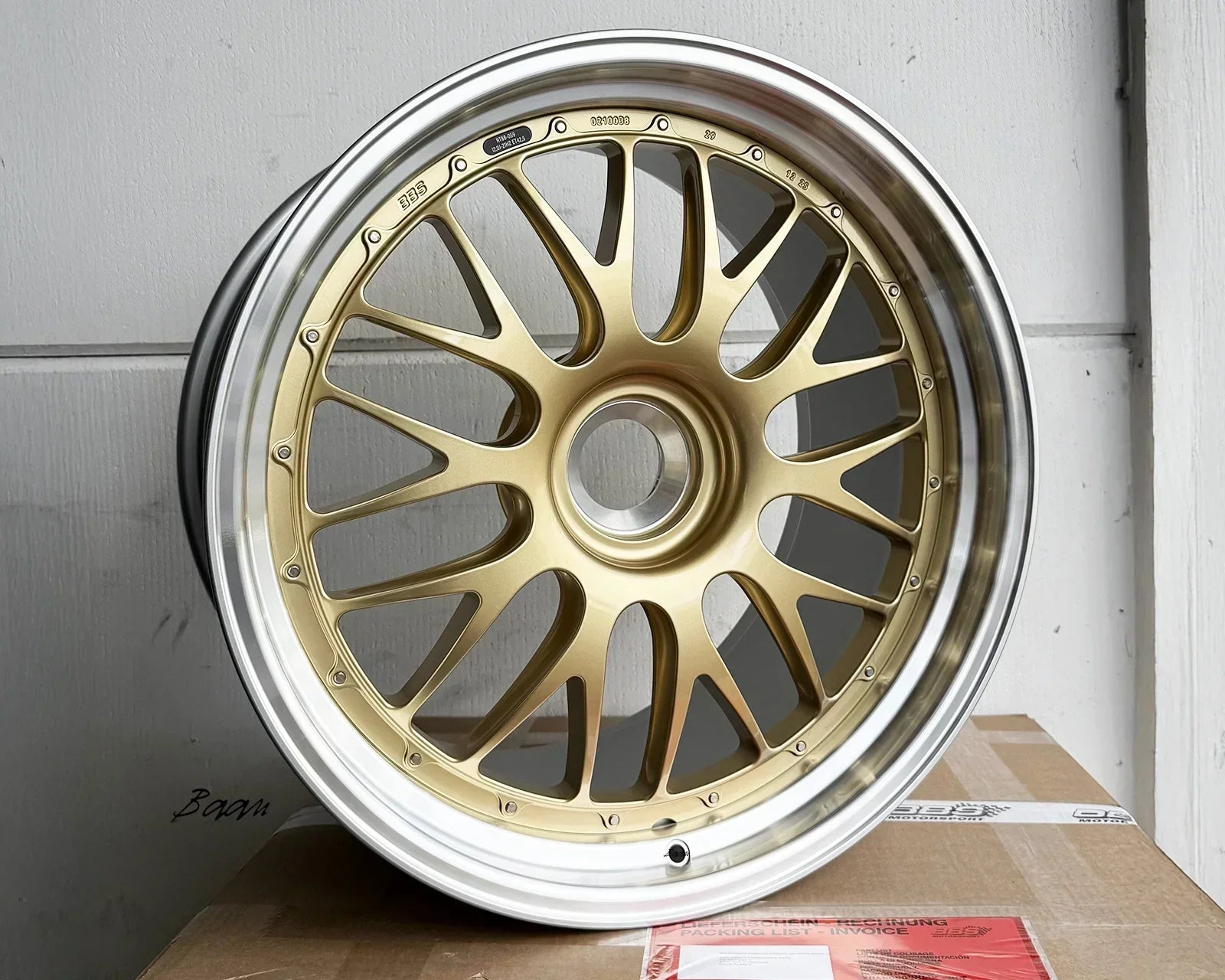
Made-to-order manufacturers such as BC Forged and Brixton Forged provide the flexibility to engineer vehicle-specific configurations once the necessary data is available. Confirmed BBS or other model-specific applications will only be added after the relevant manufacturer has released them.

Suspension, Brakes and Aerodynamics
The Neue Klasse platform will also create new requirements for suspension and chassis upgrades. A suitable lowering solution must work with the production suspension geometry, adaptive damping, electronic control systems, alignment range and available suspension travel.
Braking upgrades will need to account for the interaction between the mechanical braking system and BMW’s wheel-specific regenerative braking control. The presence of strong energy recuperation does not remove the need for thermal capacity during repeated high-performance driving.
Aerodynamic components may influence stability, cooling and efficiency as well as appearance. Product development should therefore begin from the final production bodywork rather than from concept-car dimensions or independent renders.
No suspension, brake or aerodynamic product should be described as confirmed fitment until the production vehicle has been measured or the manufacturer has provided validated compatibility data.
What About Exhaust and Intake Upgrades?
A fully electric BMW M does not create a conventional market for exhaust or intake upgrades. Those categories remain relevant to the current G80 and any future combustion-engine BMW M3, but not to the electric Neue Klasse drivetrain.
For the BMW M Neue Klasse, the principal aftermarket opportunities are more likely to centre on forged wheels, tyres, chassis development, braking, aerodynamics, weight management and OEM+ visual personalisation.
BaanVelgen’s Approach to the BMW M Neue Klasse
Our approach is to prepare early without presenting assumptions as established fact. We will monitor official BMW information and product development from the manufacturers we represent.
Vehicle-specific products will only be presented as confirmed when at least one of the following is available:
- Official production-vehicle technical data
- Verified manufacturer compatibility
- A physical vehicle assessment
- Confirmed wheel, brake and suspension measurements
Until then, our wheel collection should be understood as a selection of made-to-order designs that may be engineered for the vehicle once development can responsibly begin.
Interested in a future BMW M Neue Klasse setup? Explore the BMW M Neue Klasse collection or contact BaanVelgen to discuss your preferred wheel design and future upgrade requirements.
Frequently Asked Questions
When will the first BMW M Neue Klasse models arrive?
BMW states that the market introduction of the first BMW M vehicles using Neue Klasse technology is planned for 2027. A precise launch date and market-by-market availability have not yet been announced.
Is BMW M Neue Klasse the new electric M3?
BMW has not officially confirmed the production model as an M3. The company currently describes it as a future generation of fully electric BMW M high-performance vehicles using Neue Klasse technology.
Is ZA0 the confirmed chassis code?
No. ZA0 is commonly used as an expected or development designation, but BMW has not formally announced it as the definitive production code in its public product information.
Will the BMW M Neue Klasse have four electric motors?
Yes. BMW has officially confirmed an electric motor for each wheel, controlled through BMW M Dynamic Performance Control and the Heart of Joy central driving-dynamics computer.
What battery technology has BMW confirmed?
BMW has confirmed an 800-volt electrical architecture and a performance-optimised Gen6 battery with more than 100 kWh of usable energy.
Is the BMW M Concept Neue Klasse the production car?
No. The concept is not intended for sale. It previews design, material and technology elements that BMW says will influence future BMW M production vehicles.
Can BMW M Neue Klasse wheels already be ordered?
Made-to-order wheel designs can already be considered, but a vehicle-specific configuration should not enter production until the necessary dimensions, load requirements, brake clearance and mounting data have been verified.
Will lowering and suspension upgrades be available?
This has not yet been confirmed. Any future solution must be compatible with the production chassis, suspension electronics, alignment requirements and available suspension travel.
Will the electric model replace the combustion BMW M3?
BMW has confirmed the continuation of the existing combustion-engine M3 and M4 with M Ignite technology from July 2026. BMW has not yet published a complete longer-term model strategy explaining how a future combustion M3 and the electric Neue Klasse range will coexist.